

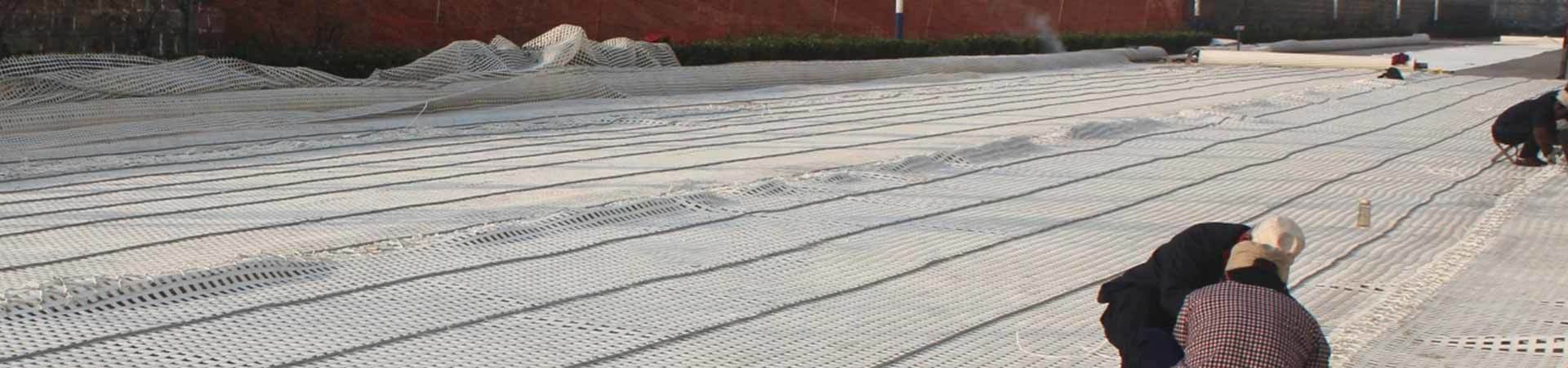
What are the construction steps of HDPE impermeable membrane? What properties does it have?
Release Time:
2024-01-05

What are the construction steps of HDPE impermeable membrane? What properties does it have? Answered Before laying HDPE seepage control membrane, a membrane laying diagram should be made according to the design and site conditions, and then the membrane laying material should be cut according to the membrane laying diagram. The membrane laying plan should consider the topography of the working surface, and the uneven part of the site and the corner part need more detailed calculation to reduce the cross weld and stress concentration.
The plane on which the HDPE impermeable membrane is to be laid shall be level and free from waste material, roots, angular rocks, etc. All fill material must be well graded and free of organic matter, trash or other harmful impurities. Rocks or debris larger than 4 cm in diameter shall not be contained in the upper 15 cm of the completed foundation and the foundation soil shall not be jagged or otherwise deleteriously affected.
The nature of the foundation should not vary greatly, nor should there be sudden changes in grade. The subgrade is at least 90% dense. The completed foundation will not be subject to rain, snow, freezing and other adverse weather conditions. Where the foundation is cracked, visibly swollen, protruding, or similar, it should be realigned to eliminate these adverse factors.
The jointing of HDPE geomembranes is a critical process that directly affects their impermeability. Commonly used joining methods include: lap joint, the lap width should be more than 15cm; heat welding, suitable for slightly thicker geomembrane substrate, the weld lap width is not less than 5cm. Adhesive bonding is not recommended, because it is easy to open the adhesive after long-term water immersion, and the seepage control effect is poor.
Product performance of HDPE seepage control membrane:
1. High impermeability coefficient: HDPE impermeable membrane has an impermeable effect that is incomparable to ordinary waterproof materials. HDPE impermeable membrane has high strength and tensile mechanical properties. Its excellent elasticity and deformation ability makes it very suitable for expansion or contraction of the substrate, and can effectively overcome the uneven settlement of the substrate. Water vapor permeability coefficient K≤1.0×10⁻¹³g.cm/CCM 2.s.pa;
2. Chemical stability impermeable membrane has excellent chemical stability, widely used in sewage treatment, chemical reaction pools and landfills. Resistant to high and low temperature, asphalt, oil, tar, acid, alkali, salt and other 80 kinds of strong acid and alkali chemical media corrosion
3. Anti-aging - the seepage control membrane has excellent anti-aging, anti-ultraviolet and decomposition resistance, can be used naked, the service life of the material can be up to 50-70 years, for the environment seepage control provides a good material guarantee.
4. Resistant to plant roots - HDPE seepage control membrane has excellent puncture resistance and can resist most plant roots.
5. High mechanical strength impermeable membrane has good mechanical strength, tensile strength at break is 28MP, elongation at break is 700%.
6. Low cost and high efficiency - HDPE impermeable membrane adopts new technology to improve the impermeability effect, but the production process is more scientific and quicker, and the cost of the product is lower than the traditional waterproof material. According to the actual calculation, the use of high-density polyethylene impermeable membrane of the general engineering costs should be saved about 50%!
7. Fast construction - seepage control membrane high flexibility, there are a variety of specifications and a variety of laying forms to meet the seepage control requirements of different projects, the use of heat fusion welding, weld strength, construction is convenient, fast and healthy.
Related News
Our Main Products
Contact Us
Address:No. 366, Industrial Park North Road, Beijipo District, High-tech Zone, Taian City, Shandong Province,China
Get a Free Quote


